The Passion of Collecting Academic Nudes

Join me as we explore my collection of Academic Nudes from the 18th, 19th, and Early 20th Centuries and serendipitous finds in the Museum, Art Auction, and Gallery world......examples from the Golden Age of the European Academie


Thursday, January 20, 2011

Rudolf Kuchler (1867 - ?) Bronze : Der Fechter - The Fencer ... ca. 1900

***********
I found this beautiful bronze of a fencer on one of the European eBay sites yesterday. Rudolf Kuchler (1867-?) was a famous Austrian sculptor who produced some very beautiful works during the late 19th and early 20th centuries. Unfortunately I could not find much biographical information on him other than a short description of his major works. He specialized in portrait busts and statuettes. His chief work was the monument at Halle, Germany to the German Emperors William I and Frederick I.
--------------------------------------------


------------------------------------------
Here are a few examples of Kuchler's other works:
------------------------------------------


Tuesday, January 18, 2011

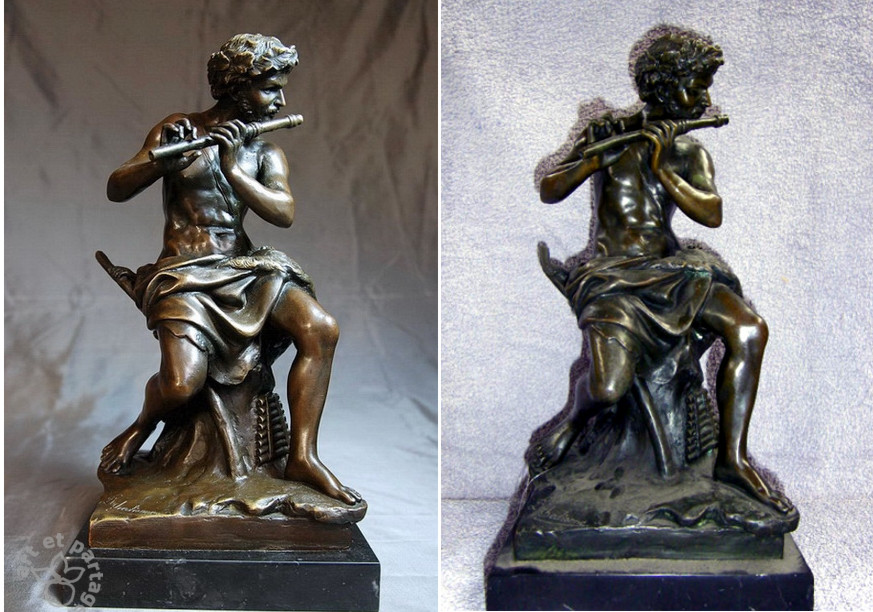
Ferdinand Barbedienne (1810-1892): 19th Century Bronze - Berger Jouant de la Flute by Antoine Coyzevox (1640-1720) A Primer and Comparison

********************
I have made a correction in the title of this bronze to show the original French title: Berger Jouant de la Flute (Shepherd Playing the Flute) by Antoine Coyzevox (1640-1720). I ordered a copy of the original 1886 Foundry Catalog from Amazon.com and there on page 31 is the original casting of this bronze. (see the illustrations below)
-----------------------------
Cover of .... "Catalogue des Bronzes D'Art"- Barbedienne Foundry, Paris 1886 (below)

The page listing for the bronze "Berger Jouant de la Flute" (Prices in 19th Century French Francs)


***********
I was browsing through eBay France this morning and spotted a re-strike of the Barbedienne bronze I bought last week. I thought it might be nice to make some comparisons between the real item and the modern re-strike. Sometimes it is difficult to determine if you are dealing with an original from the appropriate time period of the original casting and a quality modern recast. There are some specifics you should be aware of and the only way to acquaint yourself with the specifics of the original is research. It only takes one costly mistake to ruin your day when you have shelled out a respectable amount of your paycheck for a fake or posthumous re-strike. It is wise to take some time to learn the trade and know that, especially in bronzes, opportunists will go to extreme lengths to separate you from your hard earned cash with fakes and re-strikes.
**
When I see a listing on eBay with certain key words designed to get your attention by a seller who obviously has no real clue what they are doing outside their "trade" (antiquing and not dealing in original art works) (i.e. "rare"...this is a favorite word used by antiques dealers who know just enough to be dangerous). I usually just skip that seller and look elsewhere. You will find yourself dealing with someone with whom dollar signs are the bottom line first and foremost. The first thing I look for is the photograph, and then the listing title, and then the accompanying price. That first impression will always tell you plenty about the value of that listing. Only then do you proceed to the description. You must teach yourself how to recognize the hand of quality craftsmanship. My sister and I once ventured into a shop and we both were astonished at the asking price on items we knew full well could be had for much less elsewhere. Another customer overheard our conversation and laughed. His comment pretty much summed it up precisely: "This guy loves his antiques so much he wants to keep them." What a keen observation. I can't tell you how many times I have looked at an item, then at the asking price, and exclaimed to myself: "Yeah, right. In your dreams, Jack!" It all boils down to what the market will bear as far as price/value is concerned. If the seller is not in tune with the true market and the true market value of the drawing or painting or bronze, then his price will reflect his ignorance in both directions, up and down. I don't always think I can extract a bargain from a seller but I am keenly aware of what that object is worth to me and what price I think the market will bear, and coincidentally, what I might be able to sell it for if and when I get ready to let it go. I have made some killings on occasion and just barely recovered my investment in others. On other occasions in re-selling, I have lost my shirt. Every collector must be aware of the possibility of getting snookered but your best defense is education, pure and simple.
-------------------------------------
Taking At Closer Look At Bronzes:
-------------------------------------
As a result of the huge demand, bronze "editions" experienced at boom during the second half of the 19th century. A sculptor would sell a certain number of models along with reproduction rights to an editor. In the beginning of the boom the editor would have the castings made by a foundry but some smart cookie soon discovered that he could eliminate the middle man and just offer the castings directly to the public from the foundry. Ferdinand Barbedienne was one of those entrepreneurs who signed one of the first contracts for reproduction directly from the artist. Today we are trained to look for the artist's signature and that sometimes determines value but when this all started it was the subject matter itself that was important. Catalogues actually listed works by subject matter and not by authorship. The importance of the sculptors name was minimal.
------------------------------------
What Criteria Is Used to Determine the Value of a Bronze?
------------------------------------
A bronze must primarily be judged first and foremost by its plastic (giving form or shape to a substance) art qualities and second on the quality of manufacture. The "eye must speak" to you and the "eye" (your eye as a collector) must be trained to speak the language of what kind of artworks you have decided to collect. A bronze in any collection is not evaluated by its function in its environment, but for itself, as a stand alone object. In most cases, not always, especially on an online listing, you can hold it, turn it over, feel the texture of it, weigh it, and examine it from all sides. Doing this, even in photographs posted on a listing, there are certain essential elements of "quality" and "craftsmanship" which give the object its value, as much as an aesthetic object, and as a commercial investment. Let's take a look at what exactly those qualities are that you should be looking for.
------------------------------------
Chiseling:
------------------------------------
Chiseling is precise, forceful, but without curtness. It depends upon the style of subject in which the details are either rendered with great precision or are obliterated by the shaping of the object. On first sight, you should ask yourself: "How are the details of the bronze rendered?" Take a look at the two works below. Ignore the dust on the original (bronze on the right) and compare the chiseling and the quality of the casting. The bronze on the left is a modern re-cast. Look closely at the musculature of both figures. The original is crisp and the musculature is smooth and finely done (ignore any dust and slight corrosion at the seams). The musculature on the re-cast is crude in places and you can see little defects. The overall texture of the re-cast is noticeably rougher in places. The surface on the original is well cast and refined, free from the pitting you can see on the re-cast.


-------------------------------------
Patina:
-------------------------------------
Original patina is very important for real collecting connoisseurs. From the inception of a bronze casting, the patina undergoes the continued test of time. Fine, translucent, revealing the quality of the alloy beneath, the patina continues to live and give "life" to the bronze itself. It will always have many and subtle nuances. Tonalities varied widely in the 19th century, to include black, brown, or green patinas, metallic patina, and very valuable gold gilded or silvered patinas which are rather rare and greatly sought after by collectors. Looking at the re-strike and the original below, it doesn't take a genius to see the difference in the quality of the patina. The patina on the original is still alive and filled with nuance, especially in the musculature of the subject's back. The re-strike is pretty much uniform in color and lacks the nuance of the patina on the original work.


----------------------------------------
Casting:
----------------------------------------
The quality of the casting always implies the skill on the part of the casters and the foundry. Quality of the casting is simply a sign of the overall quality. Pay attention to the chiseling and of the bearing of the overall work. In the re-strike above, the Barbedienne medallion on the top surface of the lower right hand quadrant is missing. The re-strike also lacks the incised foundry number of the original (lower right hand corner of the back edge). The re-strike includes the Barbedienne signature of the original but is missing the other attributes of the Barbedienne foundry.

----------------------------------------
Other Materials:
----------------------------------------
Certain sculptors incorporated marble, ivory, quartz, and in some cases, semi-precious stones with their bronze works. Usually these works command a higher price.

---------------------------------------
Signature of the Sculptor:
---------------------------------------
In judging value you should pay more attention to the overall condition of the piece and not grant an excessive importance to the signature. Most collectors are buying a beautiful bronze and not a signature. Before 1820, signatures of sculptors rarely appeared on bronzes; only the founders' seal appeared. Signatures of the artist became general practice after 1850.

---------------------------------------
Name of the Founder:
---------------------------------------
The foundry mark appears as a seal, or again, as a signature traced like that of the sculptor. (see the above illustrations, the original contains both, the signature and the foundery medalion). Foundry marks can precisely trace the date of the casting if one knows the succession of founders to whom certain artists awarded the castings. Please note: state of preservation, accidents, overly-pronounced wear and tear on the surface of the patina, repairs, missing parts, and additions which do to conform to the original model will obviously depreciate the value of a bronze to some extent. These are but a few features that the collector must be aware, but will be a starting point for the beginning collector who wants to start a collection of quality bronzes.

Monday, January 17, 2011

Salvator Rosa (1615-1673) Intaglio Print: Pan With Two Fauns (1660)


Self Portrait, Salvaor Rosa

----------------------------------------

This little print has an interesting story. I found it listed on eBay Australia several years ago. The seller described it in such a way as to make it almost invisible to a casual buyer. He lamented that try as hard as he could he simply could not make out the signature. I looked at that signature and smiled. Of course he couldn't read it, it was written backwards. Anyone familiar with printmaking knows that marks, including a signature, when written on that printing plate, unless the artist specifically writes it backwards on the plate, will come out in reverse on the print. I didn't have the heart to tell him his mistake (I did later after the print was in my hands). I printed out the illustration on the listing, took it to a mirror and sure enough, the mystery was solved: S. Rosa. One simply has to take the print to a mirror and bingo, the signature appears the way it should. I contacted the seller and asked about the origin of the print and he told me it came out of a Brisbane estate and the owner had immigrated from England many years ago. I ended up buying the print for a few Australian dollars, in fact the postage from Australia to Florida was more than the cost of the print. When it arrived I was surprised to see that the paper had some age on it but I am not an expert on Rosa or on his prints, so I can hardly make any judgements on its authenticity. It does have some foxing on it and appears to be in good condition. Who knows, it may perhaps be the real thing. I am a sucker for anything dealing with satyrs, those randy creatures being a favorite subject of mine.

-------------------------------------------------


Caption: Pan With Two Fauns
Artist: Salvator Rosa (1615-1673)
Medium: Intaglio print
Dated: 1660
---------------------------------------------

Salvator Rosa (1615-1673)
---------------------------------------------

Rosa was a well known Italian painter and print maker who studied in Naples under the influence of Jose de Ribera. Most of his career was spent in Rome, with an interlude in Florence under the patronage of a Medici cardinal. his landscapes, marine paintings, and battle scenes are known for their wild, romantic qualities. Rosa had a flamboyant personality. He was an accomplished poet, satirist, actor, and musician.
---------------------------------------------
Here are but a few examples of Rosa's works:
---------------------------------------------


Fall of the Giants..


Friday, January 14, 2011

Book Review: 1900 Art At The Crossroads

************************
Title: 1900 Art at The Crossroads
Publisher: Harry N. Abrams, Inc., N.Y.
Date Published: 2000
ISBN: 0-8109-4303-4

--------------------------------------------------------
I wanted to get in another book review of one of my favorite books before I call it a day. You can pick up a used copy of this coffee table sized book at Amazon.com for less than ten dollars and believe me that would be a well spent ten dollars. The book chronicles the Exposition Decennale which was part of the 1900 Paris Exposition Universelle. 1900 was a year of great changes in the art world, modern masters were in their prime and those who would change the art world in the future were just coming into their own as revolutionary figures. This book contains page after page of color illustrations of paintings and sculpture (more than 500 illustrations). There is an illustrated biography section in the back of the book that includes bibliographical references. I highly recommend this volume as an addition to any comprehensive art library.

------------------------------------------------
Here are just a few of the profuse color illustrations featured in this book:
------------------------------------------------

Wilhelm Trubner ... Salome ... 1898

Anders Zorn - Red Sands - 1902


Joaquin Sorolla Y Batistida .... Sad Inheritance ... 1899


Ferdinand Hodler .... Spring ... 1901


Ferdinand Barbedienne (1810-1892): 19th Century Bronze - Berger Jouant de la Flute by Antoine Coyzevox (1640-1720)

This little diamond in the rough was listed on eBay Austria and what knocked me over about it was the low price. I think the way the seller had it listed and described made it somewhat invisible to a casual buyer. Somebody had no clue what they had. To my practiced eye it appears to be the genuine article, a late 19th century Ferdinand Barbedienne bronze reduction of Antoine Coyzevox's "Berger Jouant de la Flute." (Shepherd Playing the Flute) It was going for a song and a dance (I can't sing and I can't dance, but I can talk my way into a lot of trouble when I set my mind to it). Having no shame and at the present no money either, I contacted the seller and suggested that for a hamburger today (this bronze) I would gladly repay her next Tuesday (February 1st) a la Popeye's Wimpie. My ex-wife insists I should change my middle name to "six months, same as cash" for all my finagling and get it over with. Hey, my philosophy is: "You'll never know unless you ask, if it ain't broke for god's sake don't try to fix it, and never ever take no for an answer." Well, I have now added this nice bronze to my collection. It is a little dusty, having been spirited out of some attic in Grebenau, Deutschland, but with a little cleaning and some paste wax, it may just return to its former glory.
---------------------------------------------------
Ferdinand Barbedienne (1810-1892) Foundry Barbedienne - Paris

Ferdinand Barbedienne was a well known and well documented French metalworker and manufacturer of the 19th century. In 1838 he went into partnership with Achille Collas (1795-1859), who had invented a method for making reductions of sculpture. The firm specialized in reproductions of antique and modern sculpture and eventually employed 300 artists and workers, who produced as many as 1,200 subjects, including the work of Michelangelo, Lucca della Robbia, and Antoine-Louis Barye, as well as making busts of historical notables. By 1850 the firm was producing a wide variety of decorative objects in many styles. The firm Barbedienne, from 1851, received numerous medals at the international exhibitions, including medals in three different classes at the International Exhibition of 1862 in London. Whether busy with castings or making cannons for the French Army, the firm was always busy. Barbedienne actively pursued contracts with many well known sculptors of 19th century Paris. After Ferdinand died his nephew, Gustave Leblanc, continued the high standards set by his uncle. The foundry continued under Leblanc's stewardship until 1952.
---------------------------------------------------


Caption: Pan and Infant Faun , by Antoine Coyzevox (1640-1720)
Foundry: F. Barbedienne
Medium: Cast bronze
Dated: circa 1865-1890
Dimensions: 37cm x 18cm x 18cm

------------------------------------------------
Here are but a few of the literally thousands of examples of the Barbedienne foundry's works:
------------------------------------------------


Giovanni Lorenzo Guidotti - Late 18th Century Copper Engraving: Two Male Nudes

I managed to take one of the 18th century engravings listed on eBay France (Illustration below) for a few farthings. After some research I learned that the copper engraving on laid rag paper is a plate from Denis Diderot and Jean Le Rond D'Alembert's (editors) 18th century "Encyclopedie ou Dictionnaire Raisonne Des Sciences, Des Arts et Des Metiers." The engraver of the work is the Italian artist Giovanni Lorenzo Guidotti, who was active in the mid to late 18th century. I looked up Diderot's "Encyclopedie" and apparently intact copies of the massive 18th century work go for some big bucks. Unfortunately I could find very little biographic information on Guidotti on the web, but did see a few examples of his engraving skills. A very nice addition to my print collection.
------------------------------------------------
Caption: Book Plate, Two Male Nudes in Classic Pose
Artist: Engraver, Giovanni Lorenzo Guidotti, Italian, Mid to Late 18th Century
Medium: Copper Engraving, on laid rag paper
Dated: ca. 1758-1776
Dimensions: 44,5 cm (17.5in) by 29,00 cm (11.5 in - Approx.)

Tuesday, January 11, 2011

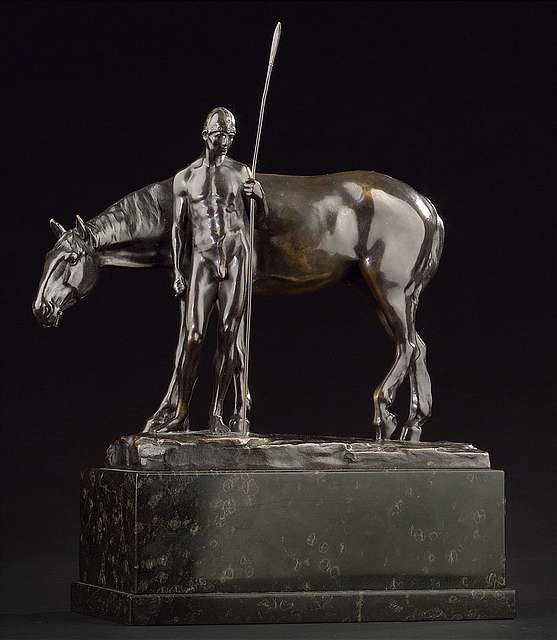
Ludwig Vordermayer (1868-1933) Romischer Krieger mit Pferd - Roman Warror with Horse (1905)

*******************************************************
I found this beautiful bronze on eBay Austria yesterday and was greatly impressed with the composition. It is obviously missing some parts (the spear and the reign connecting the horse to the rider) and has a few condition problems but is still a magnificent work of art. Unfortunately, I could not find much biographic information on Ludwig Vordermayer but I have a series of six volumes on European Bronze works coming from Amazon.com today, perhaps they will contain some useful information. Enjoy.
-----------------------------------------------


------------------------------------------------
I found additional illustrations of the same bronze and another bronze of a female nude by the same artist:
------------------------------------------------


The Slipper...


--------------------------------------------------------
I am really not sure what the below illustrations are about because the web site was in Japanese or Chinese script but it perhaps illustrates how a beautiful bronze can be damaged by corrosion of the copper in the bronze and exposure to the elements (one reason for the application of a good patina). Lord knows it could use some repair and a new patina. I thought it interesting that it appears to be an edition of Vordermayer's bronze. Bronzes are prone to a debilitating process called "bronze disease" which is deterioration of the metal from exposure to the elements and lack of proper care. The patina is applied to prevent this but sometimes deterioration still takes place. It always pays to research the medium and be knowledgeable of its proper care and conservation. This might be a preliminary casting model for the artist to review how the various castings come together and then make changes for the final edition.
--------------------------------------------------------