The Passion of Collecting Academic Nudes

Join me as we explore my collection of Academic Nudes from the 18th, 19th, and Early 20th Centuries and serendipitous finds in the Museum, Art Auction, and Gallery world......examples from the Golden Age of the European Academie


Wednesday, April 21, 2010

Update On The Gardier Restoration Project

I would like to take a few moments for an update from the restoration expert on the restoration of the du Gardier Male Nude painting. I know the photo she sent is not the best but she indicated she will update me with better photographs at a later date. The canvas has been removed from the original stretcher and the special woven Belgian Linen will be used to repair the holes and strengthen the weaknesses in the original canvas. She has already removed the grease crayon marking on the surface of the lower left portion of the painting and will begin the cleaning process after the holes have been rewoven. As soon as I receive better photographs of the work in progress I will post them. Technical restoration of artworks such as this beautiful painting is an exacting science and requires a wide knowledge of materials and artistic techniques, both antique and contemporary. As you can see from the photograph the grease pencil notations on the surface have been removed.

Monday, April 12, 2010

The Atelier Method or What You Don't and Won't Learn at University Art Schools.


When I entered the Studio Painting program in the School of Fine Arts at a very well know University here in North-Central Florida, I was under the impression that I would be taught how to paint in the style of the Great Masters of the 19th Century. I had it in my head that the Professors at the University had all this secret knowledge and were just sitting there waiting for me to fall into their clutches. Theywould empart to me all the technical aspects of painting in the Classical Realist style and life would be a journey into Elyssium Fields. I had taken all of my lower level drawing and painting courses and bounced into the program with a smile on my face. Boy was I dissappointed and ultimately disillusioned. The Professors at America's large University Art Schools can't teach you what they themselves have never been taught. Since the collapse of the great European and American Academy systems at the turn of the 20th Century with the advent of Modernism and the Gallery system, that kind of technical craftsmanship basically disappeared from our Schools of Fine Art. I really felt sorry for some of those kids in that program. One young man in particular during our Junior Painting Studio class, a really tallented and energetic artist, remarked that if he had known he would come all the way to this University to teach himself how to paint he would have stayed home. There was a point in my training at University that I knew the system I was in would not be able to teach me the skills I craved in order to do Classically themed and Contemporary Realist figurative works.

So, one summer I happened upon a summer studio in the Techniques of the Masters given at the Academy of Realist Art in Toronto, Canada. I sent in my reservation and was off to get a taste of what I wasn't learning at University. I came back from that two week course with a renewed spirit. I learned so much from that course and for the first time in my training I learned what the Fine Arts instructors at my University didn't know and couldn't possibly teach me. I learned about the sight-size method and drawing from plaster casts. I took home a greater appreciation of the Classical methods of teaching students how to draw and paint.

The current private Ateliers specializing in Classical Realism model their form of art instruction after the great Art Studio Academys of 15th to 19th Century Europe. Although the methods vary, most Atelier schools train students in the skills and techniques associated with creating some form of representational art. These skills include intensive sessions for drawing or painting from the nude model. Sight-size is the impliment modern and classical Ateliers use to teach a students drawing and painting an object exactly as it appears to the artist on a one to one scale. You are taught a form of realism based upon careful observations of nature with great attention to detail. If you would like more information on the sight-size method then the internet offers many sites where you can research the method in great detail. There are several books which also explain the method and show you how to set up your own drawing station for learning the technical aspects of the sight-size method.

I think what originally captured my attention about these mainly 19th Century drawings and paintings I have managed to collect is the artistic detail and obvious technical skills of observatrion exhibited by the artist using the site-size method.

I have listed several Modern Ateliers specializing in Classical Realism so if you would like to learn more please follow the links to their websites.

And, now let's start our journey into my collection......

A New Wrinkle In The Case of The Male Nude Painting


Well, never say never. There has been a new wrinkle in the identification of the Artist responsible for the Male Nude Academic Painting currently at the Conservationist Laboratory for restoration. The possibility of heading back to square one in now conceiveable. I received an email this morning from the kind lady in France, Arlette, who sold me the painting and she has developed some interesting information regarding the possible identity of the "Raoul le Boucher" written on the surface of the painting. According to Arlette there was indeed a very famous French wrestler around 1900 named Raoul le Boucher...."Raoul the Butcher", a name reflecting his talents in the ring I suppose. Above is a side by side comparison of a photograph of Raoul le Boucher dating around 1900 and the head of the model in the painting. I would not be surprised if le Boucher did actually pose for the life Drawing and Painting classes at the Ecole des Beaux-Arts. Gustave Moreau had a very respected reputation and would have attracted some famous models for his classes. Also above is cover art from a 1906 publication featuring Raoul le Boucher taking down a Russian wrestler. Take a look at the above photographs and let me know what you think.

I am not really convinced the model is a young Raoul le Boucher. The muscularture of the model in the painting and the part of the hair in particular does not fully match the later photographs. I am more likely to believe the Raoul le Boucher refers to Raoul le Gardier. This is typical when trying to trace the origin of any artwork, something one brings away from watching Antiques Roadshow. Over the years family myth most likely hides the truth. After looking at that color pallette on this painting and the similar color palette on le Gardier's later works that this fine academic work is more likely by his hand.

Wednesday, April 7, 2010

The Works of Raoul du Gardier


I thought I would list several examples of Raoul du Gardier's works along with the Academic Male Nude that is out for restoration before we get started on a review of my collected works.


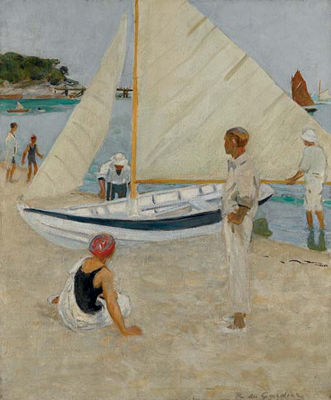
Above is a selection of du Gardier's mature works. The Conservation Expert who is doing the restoration of the Male Nude described the quality of the painting and the fact that the hand that created it was indeed the hand of a master. The materials the artist used are of high quality and the work shows a knowledgeable and sensitive hand in the rendering of the model. As I listened to her describe the color palette the artist used I was enraptured by the description and her knowledge of Art materials. I could tell from the passion in her voice that I had truly found someone who appreciates art and has devoted her life to returning great art to its former glory. Soon we will begin the journey into my collection and hopefully an appreciation of these wonderful works of art that over time have been basically dismissed as "academic works" and not reflective of the artist's mature works. I really beg to disagree with that line of reasoning because these academic works are a history of the passion and skills each of these artists developed in the early stages of their career. Considering the fight you have to put up in both money and effort to obtain a quality academic nude, I would say there are many out there in the world who share my view of these works. I know from first hand that once initiated into the academic world of the nude an artist will always come back to the basics to keep attuned to their roots. Enjoy, and let's get started on our journey........

Tuesday, April 6, 2010

Works of Art Coming from Europe

Above is an interesting "appropriation" of the drawing below that is coming from Milan, Italy after the first of June. The obviously computer generated photograph is by Giacomo Lorenzo, Maryland, who has used a single image from the Tamburini, Jr. drawing in his own creation. "Appropriation" is an age old technique in art and has served Mr. Lorenzo well in this case.


I am excited about several works which are on their way from Germany and Italy later in the month. (illustrated above) I think my second love in art is with intaglio prints and lithography. After I took my first printmaking class I fell in love with prints, the print making process, and, along the way of amassing my collection of Academic Nudes, I have tried to add select graphic works that are not necessarily considered strictly Academic works, although I will be showing a few intaglio prints I have managed to find in that category, but which do feature the nude as the central theme. Two of my favorite printmakers are Ludwig von Hofmann (1861-1945) and Lovis Corinth (1858-1925). One of the works on its way from Germany is a color Lithograph by von Hofmann. Ludwig von Hofmann attended academies in Dresden, Karlsruhe, and Munich (1883-89). He continued his training from 1889 to 1890 at the Academie Julian in Paris where he absorbed the influence of Pierre Cecile Puvis de Chavannes. If you are familiar with the works of de Chavannes then you can see the influence in his early subject matter. In 1890 he joined Die Elf, which included such great names as Lovis Corinth (1858-1925), Max Klinger (1857-1920), and Max Liebermann (1847-1935). Hofmann combines a traditional, academic style with Art Nouveau motifs. The title of the work is Reife Fruchte (Ripe Fruit..Loose translation).


The second work is by by Italian/American artist Arnaldo Casella Tamburini, Jr. (Florence 1885 - Chicago 1936). It is a work on paper in colored chalks and is titled Two Studies Of A Seated Nude Boy Playing The Flute. Tamburini trained in Italy and is known for his portraits of famous personages. He painted Sir Wilfred Laurier, Prime Minister of Canada, and a portrait of Enrico Caruso, which hangs in the Galleria d'arte Moderna di Palazzo Pitti. As well as portraits, Tamburini painted allegorical compositions and landscape.

Academic Nude by Maximilian Spilhaczek (1876-1961)


Although I have yet to received the drawing, I still wanted to post a photograph of the work just to whet your appetite. I will photograph more details and post them later for your enjoyment. Until now this will have to do.
Good news! I just spoke with the Conservation specialist and the restoration of the du Gardier painting is within the budget and will proceed. As soon as I receive photographs of the restoration I will share them with you. I really look forward to the restored painting taking a central place in my collection.

Academic Nudes by Alexis Bafcop (1804-1895)


Yesterday (April 5, 2010) I packed up the Male Nude Academic painting by Raoul du Gardier and shipped it off to the Conservation Laboratory for what I hope is its complete cleaning and repair (provided it doesn't put a giant hole in my budget). This beautifully executed male nude deserves a new life and I look forward to posting photographs of it when it returns. I have only had it in my possession for a few days but those few days have been very enjoyable. If you would like to see the website and the conservation work of a master craftswoman please visit:


I was very fortunate in finding Alexandra's website through the Fine Arts Conservancy website. She is highly knowledgeable and comes with a world of experience in the conservation of Fine Art. If I can afford a full restoration, I am sure she will post the progress on her website for you to see, if not, then I will post them here when I receive them. I am excited about having the work in such capable and experienced hands.


I also wanted to post photographs of the three new Academic Nude drawings on paper I recently received from France and Germany. The first two drawings are by Alexis Bafcop (1804 - 1895). Bafcop exhibited at the Paris Salon from 1831 to 1840. His works are displayed in several National Museums in France. The first drawing is signed and dated "Paris 18 December 1841." The other drawing us unsigned but by the same artist and is most probably from the same time period.


The third illustration on the next post is by Maximilian Spilhaczek (1876 - 1961) and is from the early 1920's. I do not usually bother with Academic Studies from the 20th Century simply because, in my humble opinion, the Acadame System of rigorous training had just about collapsed with the invention of Modernism and the Gallery system, and nothing coming out of Art Schools during this time could compare technically to what preceded it, but alas here is a notable exception. When I saw this drawing illustrated on the website, I was drawn to the expert hand that created it. Spilhaczek is a well known Austrian Artist who studied at the Vienna Academy under professors Griepenterl, Rumpler, and Lichtenfels. He exhibited regularly at the Vienna "Kunstlerhaus", the largest exhibition hall of the time. The near photographic technical nature of the work captured my attention and I had to have it for my collection.


In the coming weeks I would like to begin a journey with you through my collection and try to share with you my passion for the 19th Century Academic Nude.