The Passion of Collecting Academic Nudes

Join me as we explore my collection of Academic Nudes from the 18th, 19th, and Early 20th Centuries and serendipitous finds in the Museum, Art Auction, and Gallery world......examples from the Golden Age of the European Academie


Friday, June 4, 2010

Academic Nudes From Summer Auction Sites Online

Francois Flameng (1856 - 1923): Zwei Varianten einer Aktstudie


This last week has been a banner week for listings of 18th, 19th, and early 20th century academic drawings in various auction houses and auction sites in Europe. I thought I would take a break from photographing and displaying items in my collection and show you what is available out there online for the collector, most at affordable prices. I hope to add a few of these to my own collection. A number of the drawings are by Alexis Bafcop (1804 - 1895), whose works are already in my collection. The same models appears in several of the works. I have also included several line drawings which I hope will illustrate how the artist goes from blocking-in the overall shapes. He will then come back in and develop the drawing further, going from general to specific. Enjoy the latest crop of drawings:

Julius Huber (1806 - 1882) : Magdalena trauert am Leichnam Christi (Study)
Gustave Heinrich Naeke (1786 - 1835): Studienblatt
Johann Daniel Herz, The Elder (1693 - 1754) Mannlicher Akt
Italian School 18th Century: Sitzender Mannlicher Akt
French School, 18th Century: Standing Male Nude

Paul Schad-Rossa (1862 - 1916): Nude Ephebe ............... This drawing illustrates just how active and powerful an artist can make line work for him. The drawing, although probably a twenty minute sketch, is lean on detail but very alive and energetic. Addendum: I managed to take this drawing at auction and it should be on its way into my collection very soon. A nice energetic drawing.

Pietro Fancelli (1764 - 1850): Standing Male Figure in Classical Attire
Roman School, 18th Century: Kniender Mannlicher Akt
Julius Schorr von Carolsfeld (1794 - 1872): Stehender Mannlicher Akt
Christian Tunica (1792 - 1868): Aktstudie zweier schreitender
Christian Tunica (1795 - 1868): Aktsudie eines sitzenden jungend

Johann Daniel Herz (1693 - 1754): Mannlicher Akt

Italian School, 18th Century: Herkules mit Lowenfell
Otto Greiner (1869 - 1916): Page from one of Otto Greiner's sketch books.

Monogramist, French School 1936: Male Study
Vincenzo Dadini (1607 - 1675): Male Nude Study
Alexis Bafcop (1804 - 1895): Standing Male Nude


This beautifully executed drawing was won at auction and will be on its way into my collection shortly.


This very nice drawing is also on its way into my collection. I have another Bafcop drawing of the same model.


Wednesday, June 2, 2010

Gottlob Wilhelm (1867 - 1925) Male Nude - Watercolor


Caption: Mannlicher Akt auf Postament gestutzt
Artist: Gottlob Wilhelm (1867 - Munchen 1925)
Medium: Aquarell - watercolor on paper
Dated: 1892


This is one of several watercolors (aquarelles) of academic nudes I have in my collection. It is signed and dated "Wilhelm 1892". It is probably one of the finest academic watercolors I have ever seen. For any of you who have ever tried your hand at watercolor you probably know the one word that always comes to mind when you think of watercolor: "unforgiving." Having used drawing materials and oils to do academic nudes myself, I would be dearth to try my hand at watercolor. Oil paints and charcoal can be chased all over the canvas and ragged out, but once that watercolor hits the paper it's down for the count for all intents and purposes. Watercolor requires a certain technical mastery of the medium or else you wind up with mud on your hands. I do not have much biographic information on the artist other than his name, and places of birth and death (Munich). The drawing and execution of the watercolor itself is superb. This little work is truly by the hand of a master.

Tuesday, June 1, 2010

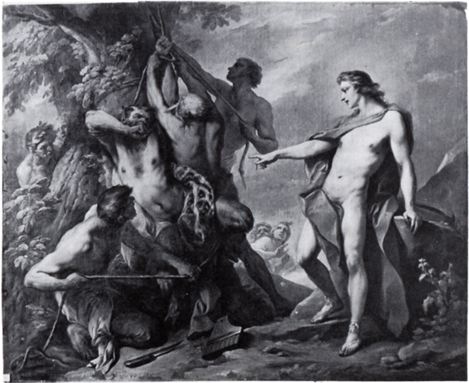
Carle Van Loo (1705 - 1765) Mature Works

Here are just a few examples of Van Loo's mature works:

Portrait of Carle Van Loo....


Carle Van Loo (1705 - 1765) Male Nude Reclining (Chalk Manner Etching)


I found this beautiful chalk-manner print of an original Carle Van Loo drawing last night at a bargain-basement price. Needless to say I snapped it up for my collection. Chalk-manner (also called crayon or pastel manner prints) are actually etchings made with a metal wheel called a roulette with a random pattern of variously sized points that was rolled over a copper plate coated with a protective wax ground. When the plate was etched in acid, the resulting pattern of dots provided a passable approximation of the original chalk drawing. Chalk-manner prints were made in as many as three colors -- black, red, and white -- from one or more copper plates worked either in etching or engraving, or in a combination of the two techniques. Special toothed tools -- roulettes, mattoirs (punches), champignons (literal translation "mushrooms), were used to create a dotted patters on the plate that suggested the grainy appearance of chalk strokes on paper.


There are two things going on here in this drawing at once: (1) a drawing from a famous artist from the 18th century and (2) an original print from very famous Master Engraver from the same time period. The engraver is Gilles De Marteau (1722 - 1776). De Marteau was born in Liege, France in 1722. After becoming a member of the Academy of Paris in 1769, he was appointed by King Louis XV to the position of Court Engraver. This prestigious appointment also provided him residential quarters at the Louver in Paris. De Marteau is considered by scholars to have been one of the most important engravers of his period. His innovative techniques in engraving, using various "casters", allowed him to achieve a quality that is similar to that of drawing. The level of beauty and perfection that he achieved, in chalk-manner etchings, provided him with the much deserved credit he received in the development of this new medium. The chalk-manner technique of printmaking was first used in 1735 by engravers Pond and Knapton in England and thereafter the French Engraver Jean-Charles Francois brought the technique to France.


Carle Van Loo (1705 - 1765) was born into a family of painters, but eventually his career overshadowed all of his famous relatives with his versatile artistic talents. He trained with an Italian painter and a French sculptor and made numerous trips throughout Italy and France. After his father's death, his training was placed in the hands of his older brother. They moved to Rome two years later and worked together on commissions. As a teen Van Loo won first prize in drawing at the Academe Royale and later took the prestigious Prix de Rome. He lived in Italy until 1733, painting religious and mythological frescoes. He then returned to Paris and painted portraits of the Royal family and decorated their apartments at Fontainbleau and Versailles. During his lifetime Van Loo was given the title of "Premier Painter to the King" under Louis XV and also became a noble to the court. His works are in numerous museums throughout the world.

Thursday, May 27, 2010

Cast Drawing: Using the Sight-Size Approach


If you are interested in learning more about the Sight-Size approach to drawing that was used to train artists in the 19th century, I highly recommend Darren R. Rousar's highly informative book titled: Cast Drawing: Using the Sight-Size Approach. You can order Darren's book directly from Amazon.com. There is a companion DVD also, Sight-Size and the art of seeing. These two items will get you started in the art of classical drawing methods.
Book Title: Cast Drawing, Using the Sight-Size Approach
Author: Darren R. Rousar
Velatura Press, Minneapolis, Mn 2007
ISBN-13: 978-0-9800454-0-6

Wednesday, May 26, 2010

Erich Kips (Berlin 1869 - 1945 Helgoland) Female Nude Study

Despite the fact that Erich Kip's work is well known on Auction sites, biographic information on the web is somewhat scarce regarding his training. He is apparently well travelled considering the subject matter of his various paintings. The only blip I could find is a short listing which describes him as a "ceramist, painter, illustrator, and decorative artist." I will have to keep digging. This nude study of a standing female nude is probably the finest oil painting sketch I have in my collection. You can tell from the drawing and the application of paint that Kips was well trained and knew exactly what he was doing. If you examine the surface of the painting closely you can see the fine brush applications of the sable brush the artist used. Truly a beautiful work of art.


Caption: Standing Female Nude
Artist: Erich Kips (1869-1945)
Medium: Oils on prepared artist board
Dated: undated. Artist's estate stamp appears in the lower right (1890-1910)
Here are a few additional academic nude studies by Erich Kips. The little study of the female child directly below is one of the very few such studies I have seen. It was posted the same time I bought the above female nude but unfortunately I was unable to add it to my collection. It was later resold at auction in Germany and into a private collection I assume.


Tuesday, May 25, 2010

Francis Simeon (1879-1954) Nude Ephebe

Caption: Nude Ephebe with Line
Artist: Francis Simeon (1870-1954)
Medium: Sanguine chalk on paper
Dated: Undated, signed in the lower left hand corner.

This little sanguine drawing arrived from Lille, France a few weeks ago. Although not very detailed in execution it is a nice example of a line drawing with a minimum amount of shading. Unfortunately I do not have much biographical information on the artist outside the dates of birth and death.