The Passion of Collecting Academic Nudes

Join me as we explore my collection of Academic Nudes from the 18th, 19th, and Early 20th Centuries and serendipitous finds in the Museum, Art Auction, and Gallery world......examples from the Golden Age of the European Academie


Tuesday, May 25, 2010

William Etty - 1787 1849 - Three Male Nudes - Pen & Ink drawing


If any thing can be said of William Etty it is that he literally put the nude on the map in the early 19th century, so much so that he drew continuous fire from his critics as being an unrepentant pornographer. Etty apprenticed to a print maker before taking up painting in 1806. He entered the Royal Art Schools in 1807 and continued to frequent life classes for his entire career. He was a pupil of Thomas Lawrence, publisher of Hull Packet and East Riding Times. He studied anatomy and proportion extensively for the following twelve years. From 1811 he exhibited regularly at the Royal Academy and the British Institution and in 1816 he worked in the studio of Jean-Baptiste Regnault in Paris. In 1822, Etty traveled through France and Italy, copying works of Titian and Rubens. After this period of travel, he created large paintings of nudes and historical scenes. Etty's nudes were criticized by the Press and deemed indecent. Luckily Etty had many wealthy patrons and eventually was given a solo exhibition at the Society of Arts in London in 1849. In 1848, he retired to his native city of York, where today the largest collection of his works can be seen. This little drawing came from a London Auction House several years ago. If you get a magnifying glass you can see a very delicate pencil drawing underneath, overlain by a pen and ink drawing and light wash. A lot of action packed into such a small drawing. Based upon their pose, I like to think of them as the "Three Male Graces", Football, Rugby, and Cricket!


Caption: Three Nude Graces, three male nudes

Artist: William Etty (1787- 1849)

Medium: Pencil sketch, pen and ink drawing with wash, overlay.

Dated: undated, early 19th century


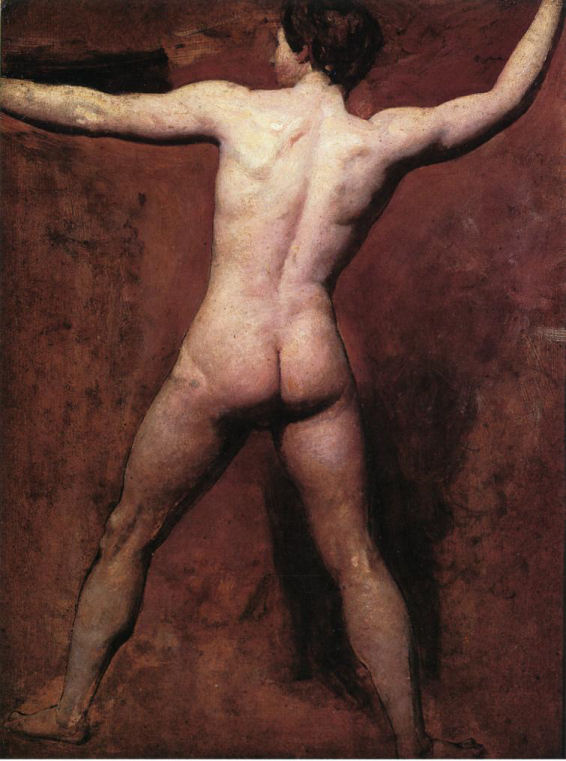
Here are only a few examples of Etty's works featuring the nude. As any good artist should, he spent many hours drawing and painting the nude:




Fanny von Jaksch - Austrian Artist


Caption: Male Nude
Artist: Fanny von Jaksch (?)
Medium: Copper intaglio print
Dated: 1919

Fanny von Jaksch (late 19th - Early 20th Century) was an Austrian female graphic artist who worked during the late 19th and early 20th centuries. I have been able to find scant biographical information on her but the academic study in my collection is impressive. This is a copper intaglio print signed and dated 1919. I think the most impressive thing about this study is the way the model stares directly into the viewers eyes. Bold as brass and proud of that body. Most models are posed in a prescribed way, staring out into the great beyond but not this guy. He is in your face and challenging in his pose.

Sunday, May 23, 2010

Anonymous - Head of Hercules - Drawing from the Plaster Cast


Caption: Bust of Hercules, from the plaster cast
Artist: Anonymous
Medium: Charcoal on paper
Dated: undated; circa late 19th Century


I keep finding these little gems on eBay France. This evening I found and bought this beautiful 19th century drawing of Hercules from the plaster cast. Before a student was allowed to draw the nude from life he had to complete a series of sight-size drawings from the plaster cast. This is a beautiful example 0f 19th century cast drawing. Not technically a nude but well worth adding to the collection as an example of the technical expertise acquired by the Artist in the late 19th century Academe. This drawing came from Paris and was most probably from the Ecole des Beaux-Arts. It has some minor foxing and a bit of worm hole damage but still a beautiful work of art.

Friday, May 21, 2010

What is Academic Art?


This evening I ran across a short article on the Dahesh Museum website describing "Academic Art" and I thought I would share it with you:

"Academic art refers to the tradition of drawing, painting, and sculpture taught at the academies, or art schools, of Europe. First established in Renaissance Italy, academies flourished in the 19th century and prescribed strict guidelines for the production of works of art. This organized training system ensured that artists possessed a high level of technical ability and familiarity with the lofty themes of the Western tradition. Nearly every city in Europe, and, later, the United States, Australia, and Latin America developed an art academy that set similarily high standards.

The most important academy of the modern period, and the one upon which many others modeled their own systems of promotion, patronage, display and teaching, was the French academy, founded in 1648. During most of the 19th century, this powerful institution oversaw the premier art school in Paris, the Ecole des Beaux-Arts, and controlled the official exhibitions known as Salons. It established strict hierarchy for valuing subject matter, with history paintings at the pinnacle, and also awarded the most prestigious honor a French art student could receive, the prix de Rome."


Of course the snooty French weren't about to let just any old riff-raff artist who strayed across the French border into their premier academy, especially women.....mon dieu! The Academy Julian became an alternative to the official French academy. Established in 1868 by Rodolphe Julian, the Academy Julian hosted foreigners and, god-forbid, women, who were not allowed into the Academie des Beaux-Arts until 1897. The Academy was popular with Americans and many leading artists spent time there.


The first Academy of Art was founded in Florence, Italy in 1562 by Giorgio Vasari, who named it the Accademia dell'Arte de' Disegno. There students learned the 'arti del disegno' and included lectures on anatomy and geometry. Another Academy, the Accademia di San Luca (named after the patron saint of painters, St. Luke) was founded about a decade later in Rome. The Accademia di San Luca was more concerned with art theory. The Accademia di San Luca later served as the model for the Academie Royal de Pienture et Sculpture founded in France in 1648 and which later became the Academie des Beaux-Arts. The Royal Academie was founded in an effort to distinguish artists "who were gentlemen practicing a liberal art" from meer creftsmen, who were deemed to be engaged in manual labor. The resultant emphasis on the intellectual component of artmaking had a considerable impact on the subjects and styles of academic art.

Auguste-Hyacinthe DeBay (1804-1865) Nude Ephebe


This morning I had the good fortune to obtain a new addition of an early 19th Century drawing to my collection. The drawing is attributed to Auguste-Hyacinthe DeBay (1804-1865). It dates circa 1823 and is a nude ephebe in a standing frontal pose. I think the attribution is accurate based upon stylistic similarities in the execution of the drawing and examples of DeBay's engravings. Take a look at the engravings listed below and compare the stylistic similarities for yourself.

Auguste-Hyacinthe DeBay (1804-1865) is a well know French Master. From 1830 DeBay exhibited at the Paris Salon in both paintings and sculpture. He exhibited in the 1855 Exposition and was awarded a first class medal for his sculpture 'Cain and Abel'. As soon as the drawing arrives I will photograph it and post additional illustrations.


Caption: Nude Ephebe, Standing, Frontal View
Artist: In the manner of Auguste-Hyacinthe DeBay (1804-1865)
Medium: Charcoal on paper
Dated: Circa 1823

Here are a few examples of Auguste-Hyacinthe DeBay's mature work: